DCMS Committee Review of Arts Council England: To what extent is Comedy a neglected artform?
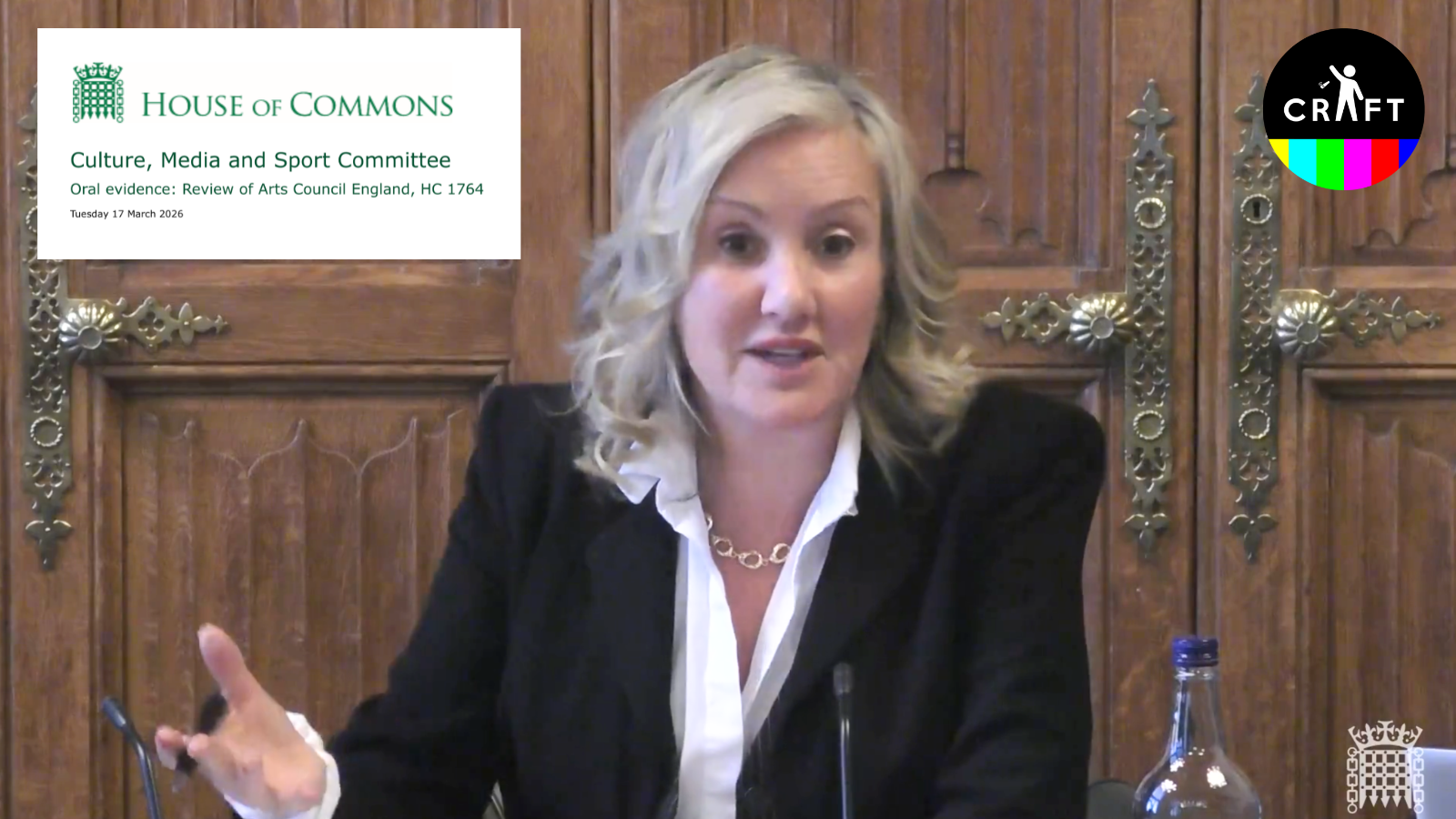
‘COMEDY’ within the Oral evidence: Review of Arts Council England
In 2025, Baroness Margaret Hodge was appointed by the Secretary of State for Culture, Media and Sport, The Rt Hon. Lisa Nandy MP, to conduct an independent review of the Arts Council England (ACE). The survey was managed by the Department of Culture, Media and Sport (DCMS) and the call for evidence ran from February to June 2025. Baroness Hodge was supported by an Advisory Panel featuring experts from across the creative sectors—covering strategic objectives, working relationships and partnerships, and the relationship between ACE and government.
Comedy is not formally recognised as a standalone artform with ACE, the Creative Industries Council, the NHS, the Charity Commission, and other key institutions. This directly impacts public investment and support into the sector—money is not flowing downstream to grassroots professionals and businesses.
On March 17, 2026, the DCMS Committee ‘Oral evidence: Review of Arts Council England’ commenced. We thank Committee Chair and CRAFT patron, Dame Caroline Dinenage, for asking Baroness Hodge a series of questions on comedy, including:
“the Arts Council review did not mention comedy”,
“to what extent do you think that comedy is a neglected artform?”, and
“should the Arts Council be considering comedy as an artform in its own right?”.
The CRAFT Newsroom offers you a timeline from June 2025 to March 2026, showing our communications regarding recognition comedy as an artform. We will formally reply to the DCMS Committee in respect to the comedy questions and answers provided at the Oral Evidence session on March 17. We would like to work with the Committee, DCMS, ACE and Baroness Hodge, to give comedy the recognition it deserves. If not now, when?
Tuesday 17 March 2026
Chair Dame Caroline: We have a series of inquiries that we do called State of Play, where we give any individual or organisation the opportunity to bid for a one-off session with us. They get to set out the obstacles and challenges that they are experiencing and what the solution is. The very first one we did was with the live comedy sector. Its big ask is to be recognised as an artform. Baroness Hodge, your review did not mention live comedy.
Baroness Hodge of Barking: No, it did not.
Chair Dame Caroline: It cannot access Arts Council funding. If it is a comedy club, for example, it cannot access Arts Council funding unless it does something else as well, such as being a live music venue or something else. To what extent do you think that live comedy is a neglected artform? Should the Arts Council be considering it as an artform in its own right? What will you be doing to celebrate National Comedy Day on 1 April, Baroness Hodge?
Baroness Hodge of Barking: My grandchildren will be taking the mickey out of me. I will be the butt of it. It is an interesting question. I was approached by choirs. I thought about choirs quite a lot, and it is too difficult to extend it. There are so many questions to do with how you would then define which choir could be subject to funding. What if it is just a community choir? It was just too difficult. I felt, “Oh God, we can’t do that at the moment.”
There is a case for comedy. I have not thought about it in detail. There is a case for saying that it should be considered as an artform. You are doing that with resources being constrained, that is the only thing. If you fund it, you are funding it at the expense of something else. That is the difficulty.
Chair Dame Caroline: It just wants a level playing field, does it not?
(Note: Baroness Hodge is entirely independent of Government, DCMS and ACE and is not speaking on their behalf)
Comedy WAS NOT LISTED AS A SECTOR ON THE ACE REVIEW Survey
The ACE Review Survey asked:“Which best describes the sector(s) which you or your organisation work in?”.
Unfortunately, comedy was not listed as a sector in the Arts Council Review Survey (see Image 1). This resulted in the comedy sector not leaving feedback, refusing to give feedback (anger/upset), or selecting “Non-Discipline Specific/Other”.
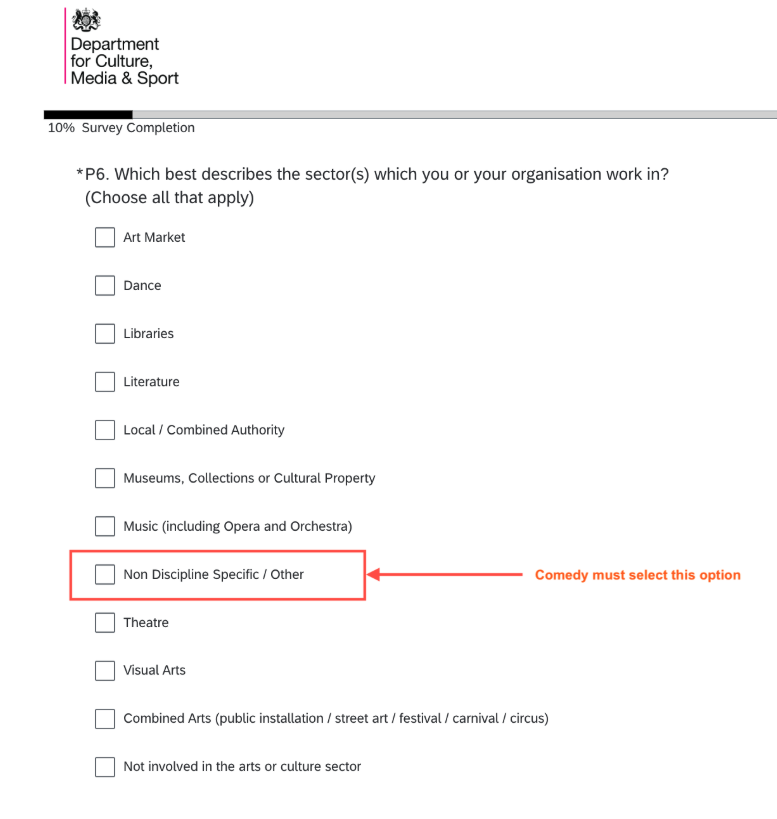
Image 1: Comedy sector not listed
Comedy needs to be seen to be heard. Because comedy is systemically omitted from government and key institution consultations, like the ACE Review Survey, it means there is minimal trackable data on the sector. Without proper measurement, it is too easily overlooked in policy, funding and strategic planning. If we do not measure the sector properly, it becomes easier to exclude by default, and easier to mistake invisibility for lack of value.
Since 2021, Lu Jackson, CRAFT Founder and Chair, has advocated for comedy to be recognised by government and key institutions, including Arts Council England. Throughout May to June 2025, Lu worked with the DCMS to provide a simple and concise case for recognition and reform for comedy (see the letter below). This case was presented by Lu, on behalf of the comedy industry, to Baroness Magaret Hodge and the DCMS.
Note: CRAFT launched on March 5, 2026. Before this date, Lu Jackson was advocating in a solo capacity (as Founder and CEO of technology platforms Craic and Craic Health).
letter to Baroness Hodge and DCMS—by Lu Jackson, on behalf of the comedy industry: THE CASE FOR COMEDY RECOGNITION
Monday June 30, 2025
Comedy is one of the UK’s most publicly consumed and culturally resonant artforms—yet it is excluded from formal recognition by the Arts Councils. This structural omission blocks access to funding, data, and strategic development, leaving the sector under-resourced and under-protected at a time of unprecedented technological disruption.
We are calling for one urgent, measurable change:
Fair & equal recognition: Comedy must be explicitly recognised as a distinct ACE artform, unlocking essential funding and support channels for sustainable growth.
Without this, the Arts Councils cannot credibly claim to be inclusive, nor to serve the creative realities of the country it represents.
/THE ISSUE: STRUCTURAL EXCLUSION
Comedy is not a recognised artform in ACE systems. Applicants must tick Combined Arts or Theatre — even with the ACE Review Survey, the comedy industry had to select “Non-discipline specific / Other”, reinforcing its invisibility within strategy and data. By contrast, commercial platforms already reflect this reality: if you visit Ticketmaster or Netflix, comedy is not hidden under “theatre” or “music”—it is a standalone category.
This exclusion means comedy cannot be properly tracked, funded, or prioritised within ACE’s strategy or reporting.
Comedy is the most marginalised creative industry in the UK. Its exclusion from ACE sends the message that it is less serious, less valuable, and less worthy than institutionally backed artforms. For many in the sector, this feels unjust and disrespectful, reinforcing a long-standing sense of being treated as an outsider in the publicly funded arts landscape.
Many applicants omit the word “comedy” from ACE funding applications altogether—due to past rejections and the widespread perception that comedy is unlikely to be funded under current criteria.
As a result, comedy is structurally absent from ACE’s strategy, portfolio, and data, which onwards impacts key government documents, including critical tech and AI reports.
/THE EVIDENCE: COMEDY DOESN’T GET FUNDED
ACE National Portfolio Organisations (NPO) Funding & Comedy 2010–present: A request for information of the NPO awards indicates no dedicated comedy-specific organisations funded (e.g. a comedy club). Only six theatres and combined arts groups received £7.5m (2015), using the applicant name, project title, or sub-classifier containing the word ‘comedy'.
During the 2020 Culture Recovery Fund, comedy received just £3.8m out of £1.87bn—despite widespread venue closures—because it was not recognised as an eligible category until late in the process. Many businesses have never recovered, including many comedy-specific venues and comedy brands with venue residencies.
This structural exclusion doesn't just affect ACE funding—it cascades across other institutions as well, limiting access to wider public investment, innovation funds, and cross-sector partnerships. As a result, comedy has in total been awarded just £14.4m over the past 25 years (all key institutions), averaging £576k per year—equivalent to just 0.003% of the £16.7bn available annually from DCMS and UKRI.
/THE IMPACT: ECONOMIC, PUBLIC, AND CULTURAL VALUE
Comedy is the top-performing category across podcasts, digital video and film—far outpacing many traditional artforms in reach and relevance.
The UK’s comedy economy supports thousands of SMEs—including talent, clubs, touring circuits, producers, writers, editors, digital creators and technical crews. It contributes significantly to tourism, exports, tech platform revenue and the wider experience economy.
Unlike ACE’s recognised artforms—many of which have benefited from centuries of elite patronage, institutional infrastructure, and public subsidy—comedy is rooted in working-class, grassroots culture. It lacks the safety nets—and people—that have historically protected other sectors. And yet, comedy is one of the most accessible entry points to the arts for people outside institutional networks—in particular men.
It delivers proven public health benefits. Initiatives like Comedy-on-Prescription are showing measurable improvements in mental wellbeing, confidence and community connection—especially among socially isolated groups.
With the rise of AI, income streams from voiceover, writing and research are all but gone. Comedy is one of the first sectors to be commercially disrupted—and the least protected. Without structural backing, comedy will be hollowed out—independent wealth will be needed to sustain creative work.
/SUMMARY
1. Arts Council England must formally recognise comedy as a standalone artform—not symbolically, but with full inclusion across strategy, funding frameworks, application systems, and portfolio decisions.
2. This recognition must come with ringfenced support and structural safeguards to ensure comedy is not marginalised in practice by institutionally entrenched artforms, which already dominate ACE’s funding landscape.
3. Without meaningful change, comedy will remain excluded—despite clear public demand, measurable social impact, and significant economic potential—at a time of unprecedented technological disruption in this AI era.
Comedy is not asking for more money from ACE—just a fair share of the public funding that already exists.
Baroness Hodge REPLY TO LU JACKSON RE ACE Review
Tuesday 16 Dec 2025
Dear Louisa,
I want to express my sincere thanks to you for your invaluable input and engagement.
I am pleased to confirm that my independent review of Arts Council England has now been published and can be accessed here.
Throughout this process, the commitment and the insightful contributions from stakeholders such as yourselves have been remarkable. It is this broad perspective, drawn from across the cultural sector and encompassing a diverse range of experiences and specialisms, that has shaped the final recommendations. I have tried to build a consensus in developing the recommendations, and believe they are a reflection of the dedication and collaborative spirit shown by all participants.
I hope this report will help lay the groundwork for a more robust and vibrant cultural sector, with Arts Council England playing a key, positive role in its future.
Thank you once again for lending your voice and knowledge to this critical piece of work.
With best wishes,
Baroness Margaret Hodge
CRAFT, the Comedy Representation and Artform Trust, is the national body for UK Comedy and is a Charitable Incorporated Organisation (CIO in formation). We are focused on Five Pillar areas for the comedy industry. The above article relates to Pillar 4: Public Affairs, Policy, & Representation, where we ensure comedy is recognised as a standalone artform across all formats (live, broadcast, recorded, digital/hybrid, writing and visual/illustrative formats), so policy decisions and funding reflect its true role and value; widen who gets to participate and progress; and protect lawful satire and social commentary.
Subscribe to our RSS feed or newsletter + follow our socials for future updates.